
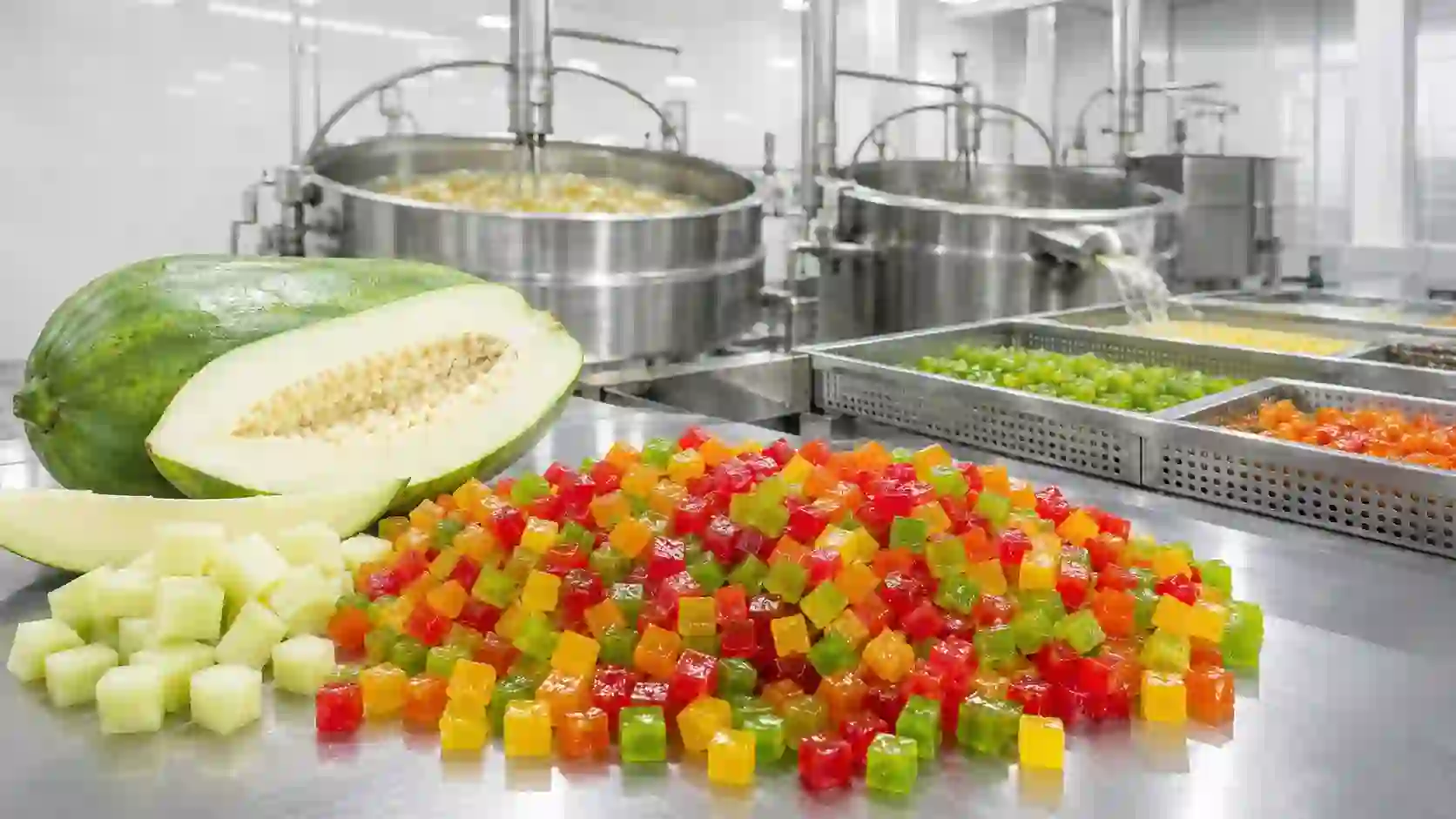
Tutti Frutti Manufacturing Process
Tutti frutti is manufactured from firm, raw papaya through a controlled process of washing, peeling, cutting, blanching, sugar syrup absorption, colouring, drying and packing.
Each production stage affects the final cube size, sweetness, colour, texture and shelf stability. A properly controlled process produces uniform candied papaya cubes that remain separate, chewy and suitable for use in cakes, ice cream, confectionery and desserts.
Manufacturing overview
- Product: Tutti frutti / candied papaya dices
- Standard cube size: Uniform 5 mm cubes
- Available colours: Red, green, orange, yellow and mixed
- Main stages: Cutting, blanching, candying, colouring and drying
- Quality targets: Uniform size, stable colour and non-sticky texture
- Applications: Bakery, ice cream, confectionery and desserts
How Tutti Frutti Is Manufactured Step by Step
The following stages explain how raw papaya is transformed into finished tutti frutti at a commercial manufacturing facility.
Selection of raw papaya
Firm and fully developed unripe papayas are selected. Soft or ripe fruit is avoided because it can break down during blanching and syrup processing.
Washing, peeling and deseeding
Papayas are thoroughly washed to remove surface dirt. The skin and seeds are removed, leaving clean, firm papaya flesh for cutting.
Cutting into 5 mm cubes
The prepared papaya is cut into uniform 5 mm cubes. Consistent cutting supports even cooking, colour absorption and appearance in finished foods.
Blanching the papaya cubes
The cubes are briefly treated in hot water. Blanching softens the tissue, reduces the raw flavour and prepares the papaya to absorb sugar syrup.
Preparing the sugar syrup
A measured sugar solution is prepared and heated in food-processing kettles. Its concentration is controlled so sweetness develops gradually without damaging the cubes.
Candying and syrup absorption
Blanched cubes are immersed and cooked in syrup until sugar penetrates the papaya tissue. This stage creates the characteristic sweet taste, body and chewy texture.
Adding permitted food colours
The batch is divided when multiple colours are required. Approved natural or synthetic colours are evenly blended to produce red, green, orange or yellow cubes.
Resting and maturation
The coloured cubes are allowed to rest in syrup so sweetness and colour distribute evenly throughout the batch.
Draining excess syrup
The cubes are transferred to clean draining trays. Excess syrup is removed to prevent wet surfaces, clumping and uneven drying.
Controlled drying
The drained cubes are dried under hygienic conditions until the required surface dryness and moisture level are achieved.
Sorting and quality inspection
Broken, oversized, undersized or discoloured pieces are removed. The finished batch is checked for cube size, colour, Brix, moisture and texture.
Weighing, sealing and packing
Approved tutti frutti is weighed into food-grade pouches, sealed to protect it from moisture and contamination, and placed in cartons for storage and supply.
Standard Bulk Product Specifications
Industrial food users need measurable specifications rather than colour and appearance alone. The following values explain the principal targets controlled during manufacturing; final values should be confirmed in the approved product specification and batch Certificate of Analysis.
| Parameter | Standard specification | Buyer benefit |
|---|---|---|
| Product | Candied papaya dices / tutti frutti | Ready-to-use commercial ingredient |
| Cube size | 5 mm | Even distribution in cakes and desserts |
| Brix | 65–70° Brix | Consistent sweetness and candied texture |
| Moisture | Below 15% | Improved handling and shelf stability |
| Colours | Red, green, orange, yellow or mixed | Flexible product development |
| Shelf life | 12 months under recommended storage | Suitable for import and distribution cycles |
| Storage | Cool, dry place away from sunlight | Protects colour, texture and quality |
Natural and Synthetic Colour Options
Different markets and food brands follow different colour policies. We can manufacture conventional bright-colour tutti frutti as well as natural-colour variants, subject to the buyer’s formulation, target shade and destination regulations.
Synthetic red
Carmoisine (E122) for a bright and stable red shade where permitted.
Synthetic orange
Sunset Yellow FCF (E110) for a vibrant orange appearance.
Synthetic green
A permitted colour blend using Tartrazine (E102) and Brilliant Blue FCF (E133).
Natural red
Beetroot Red (E162) for brands seeking a plant-derived red option.
Natural orange
Paprika Extract (E160c) for a plant-derived orange shade.
Natural yellow
Curcumin (E100) for a plant-derived yellow colour.
Important: Colour permissions and labelling requirements vary by country. Buyers should share their destination and approved additive requirements before production.
Tutti Frutti for Industrial Food Applications
Consistent 5 mm cubes allow manufacturers to dose and distribute tutti frutti efficiently across large production batches.
Cakes and bakery
Fruit cakes, plum cakes, muffins, cookies, buns, bread and festive bakery products.
Ice cream
Tutti frutti ice cream, frozen desserts, kulfi, sundaes and flavour inclusions.
Confectionery
Chocolate inclusions, candy products, sweet mixes, snack bars and decorative toppings.
Desserts
Falooda, custard, halwa, kheer, puddings, milkshakes and traditional sweets.
Food service
Bulk packs for hotels, restaurants, cafés, caterers and institutional kitchens.
Retail brands
Retail-ready or private-label packing can be discussed for suitable order quantities.
Equipment Used in Tutti Frutti Production
Food-grade equipment and clean processing surfaces help maintain batch consistency and hygienic handling throughout manufacturing.
Cutting equipment
Produces consistent cubes for uniform processing and final appearance.
Food-processing kettles
Used for controlled blanching, syrup preparation and candying.
Draining and drying trays
Allow excess syrup to drain while supporting hygienic and even drying.
Weighing and sealing machines
Help maintain pack-weight accuracy and protect the finished product.
Quality Control for Bulk Orders
Large orders must remain consistent from the first carton to the last. Our quality checks focus on the factors that directly affect industrial use, transport and customer acceptance.
- Cube uniformity
Checks for consistent 5 mm cutting and minimal broken or irregular pieces.
- Colour consistency
Batch shades are compared with the confirmed specification or approved sample.
- Brix and moisture
Key values are monitored to support sweetness, texture and storage performance.
- Hygienic handling
Controlled processing, drying, inspection and packing reduce contamination risks.
- Packaging integrity
Pouches and cartons are inspected for sealing, marking and transport readiness.
- Batch traceability
Production and packing details are linked to batch identification for order records.
Critical Controls During Manufacturing
Small variations in raw material, heat, syrup strength or drying can change the finished product. These controls help keep every batch consistent.
Papaya maturity
Only firm, unripe fruit should be used to prevent soft or broken cubes.
Cube dimensions
Uniform cutting supports equal syrup and colour absorption.
Blanching time
Under-blanching leaves a raw texture; excessive blanching can soften the cubes.
Syrup concentration
Gradual sugar absorption helps avoid hard surfaces or uneven sweetness.
Colour dosage
Measured addition and thorough mixing keep the shade consistent across the batch.
Final moisture
Controlled drying reduces sticking without making the cubes excessively hard.
Common Manufacturing Defects and Their Causes
Identifying process defects helps manufacturers correct the cause before the product reaches the packing stage.
- Soft or broken cubes
Often caused by ripe papaya, excessive blanching or rough handling.
- Uneven sweetness
Can result from irregular cube size, insufficient soaking or poorly controlled syrup concentration.
- Patchy colour
Usually linked to inadequate mixing, inconsistent dosage or insufficient resting time.
- Sticky cubes
May occur when excess syrup is not drained or the product is packed before adequate drying.
- Hard texture
Can be caused by rapid candying, excessive drying or an overly concentrated syrup.
- Colour fading
Can result from unsuitable colour selection or prolonged exposure to heat, light or moisture.
Finished Product Quality Checks
Before packing, the completed batch is evaluated against defined physical, chemical and sensory requirements.
Physical examination
Cube size, broken pieces, foreign matter and surface stickiness are checked.
Sensory examination
Colour, sweetness, aroma, chewiness and absence of off-flavours are evaluated.
Chemical parameters
Brix and moisture are checked against the approved product specification.
Microbiological testing
Required laboratory parameters are tested according to the quality plan.

This content has been reviewed by Chetan Pawar, Export Head at Rajveer Exim, for the accuracy of the tutti frutti manufacturing stages, product specifications, quality controls and packing information.
View full profile →Frequently Asked Questions
What is tutti frutti made from?
Indian tutti frutti is mainly manufactured from firm, raw papaya. The papaya is cut into cubes, blanched, candied in sugar syrup, coloured, dried and packed.
Why is raw papaya used?
Raw papaya has firm flesh that retains its cube shape during blanching and candying. Ripe papaya is softer and may break during processing.
What is the standard cube size?
The papaya is commonly cut into uniform 5 mm cubes so it cooks evenly and distributes well in bakery and dessert products.
Why are papaya cubes blanched?
Blanching softens the raw papaya tissue, reduces its raw flavour and prepares the cubes to absorb sugar syrup more effectively.
How does papaya become sweet and chewy?
The cubes are gradually processed in concentrated sugar syrup. Sugar enters the papaya tissue and develops the characteristic candied sweetness and chewy texture.
When is colour added during manufacturing?
Colour is added during or after syrup processing, depending on the production method. The batch is mixed and rested to obtain an even shade.
Why does tutti frutti become sticky?
Stickiness can occur when excess syrup is not drained, moisture remains too high or the cubes are packed before adequate drying.
How is finished tutti frutti tested?
The final batch is checked for cube size, colour, taste, texture, Brix, moisture, foreign matter and relevant microbiological parameters.
How is tutti frutti packed after production?
After inspection, the product is weighed into clean food-grade pouches, sealed against moisture and contamination, and placed in protective cartons.
Need consistently manufactured tutti frutti?
Share your required quantity, colours, cube size and packaging to receive product specifications and a customised bulk quotation from Rajveer Exim.